Start Here
What Do You Need to Know?
Magnet fishing sits in a legal gray area in many states — and the rules differ dramatically depending on where you drop your magnet.
Federal Rules & Overview
No single federal law governs magnet fishing, but federal waterways, navigable rivers, and Corps of Engineers lands all have their own rules.
Read the overview →Found a Gun or Weapon?
One of the most common magnet fishing finds — and one of the most legally serious. Here's exactly what to do and what never to do.
Legal steps to take →State Parks & Protected Areas
Most state parks either ban magnet fishing outright or require a separate permit. Check the rules before you go.
State park rules →Unexploded Ordnance (UXO) Finds
Military ordnance in rivers is more common than most hobbyists realize. Every step you take after finding it matters legally.
Safety & legal guide →Bridges & Urban Waterways
Bridge access, riparian rights, and municipal waterway restrictions — the legal patchwork that catches beginners off guard.
Bridge rules guide →Magnet Weight Calculator
Enter your target object weight and material to find the minimum pull force you need for a reliable retrieve.
Use the calculator →Magnet Fishing in the Field
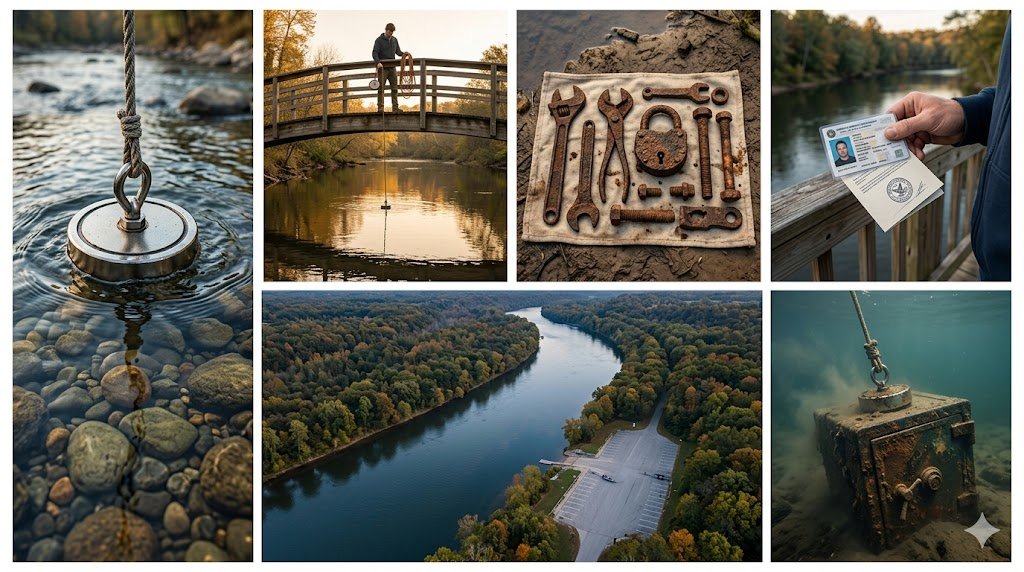
State-by-State Laws
Find Magnet Fishing Laws in Your State
Every page covers: legal status, permit requirements, restricted waterways, state park rules, historical artifact reporting, and local contacts.
Guides & Articles
In-Depth Magnet Fishing Legal Guides
These aren't beginner summaries — each guide covers specific legal situations, procedural steps, and real-world details you won't find on Reddit.
Is Magnet Fishing Legal in the U.S.?
Federal rules, navigable waterway doctrine, Army Corps of Engineers, and why "it's legal" is never the full answer.
Read →Found a Gun? Here's What the Law Requires
Step-by-step legal obligations when you pull a firearm from a waterway — by state and federal standard.
Read →Magnet Fishing From Bridges — Know the Rules
Bridge ownership, traffic codes, riparian access, and the specific cities that have banned it outright.
Read →What to Do If You Find Unexploded Ordnance
UXO in rivers is real. This is the exact protocol EOD and local law enforcement expect you to follow.
Read →Magnet Fishing in State Parks
Which states allow it, which require a permit, and which will confiscate your gear on the spot.
Read →Historical Artifacts: What the Law Says
ARPA, state antiquity laws, and why keeping that "cool old thing" could be a federal offense.
Read →Best Legal Locations for Magnet Fishing in the U.S.
Where to go without worrying about trespassing charges — public access points, boat ramps, and more.
Read →How to Report Your Magnet Fishing Finds
When reporting is legally required, who to call, and how to document the chain of custody.
Read →Rivers vs. Lakes: Different Rules, Same Hobby
Navigability doctrine, riparian ownership, and why a river and a lake one mile apart can have completely different rules.
Read →Complete Beginner's Legal Guide
Everything a new magnet fisher needs to know before their first drop — legal, safety, gear, and reporting in one place.
Read →Cord, Rope & Retrieval Line — Does It Matter Legally?
Some waterway restrictions are triggered by equipment type. Here's what to know about line regulations.
Read →Strongest Magnets for Magnet Fishing — Legal Considerations
Are high-powered neodymium magnets legal everywhere? Surprising answer: not always.
Read →Magnet Fishing Etiquette & Community Rules
How to avoid conflicts with other recreationists, property owners, and local governments — and stay legal doing it.
Read →Magnet Fishing Clubs & Groups in the U.S.
Organized groups often have legal access arrangements that solo fishers don't — and they know local rules cold.
Read →Magnet Fishing on YouTube — Legal Pitfalls to Avoid
Filming on public waterways, posting firearm finds, and the ways content creators have gotten in legal trouble.
Read →Free Tool
Magnet Pull Force Calculator
Estimate the minimum magnet strength you need to retrieve common objects from waterways.
FAQ
Common Legal Questions
There is no single federal law that explicitly bans or authorizes magnet fishing. In most states, it is technically legal on publicly accessible waterways — but with significant caveats. Army Corps of Engineers managed waterways require compliance with 36 CFR Part 327. State parks often prohibit it entirely or require a permit. Some municipalities have passed specific ordinances. The short answer: legal in most places, but always check local rules first. See our full federal and state overview.
In nearly all U.S. states, a standard fishing license is not required for magnet fishing because it is not considered fishing under fish and wildlife statutes — no bait, lure, or hook is involved, and no fish are targeted. However, South Carolina is a notable exception — it has been the subject of specific guidance from state wildlife officials. Always verify with your state fish and wildlife agency before assuming no license is needed.
Do not take the firearm home. Do not attempt to clean, fire, or disassemble it. In most states, you are legally required to turn it over to law enforcement — transporting a found, potentially stolen, or unregistered firearm can expose you to criminal liability even if your intent was lawful. Call your local non-emergency police line, document the find location with a photo, and let officers take possession. See our complete guide: Found a Gun While Magnet Fishing.
It depends entirely on what you find. Scrap metal, bicycle frames, tools — generally yes. Firearms — no, must be turned over. Items that appear to be historically or archaeologically significant — no, reporting is required under the Archaeological Resources Protection Act (ARPA) or state antiquity statutes. Cash and valuables may be subject to state abandoned property laws. When in doubt, report it. See Historical Artifacts & the Law.
No state has a blanket statewide ban on magnet fishing, but several locations effectively prohibit it: most National Park Service lands, many state park systems (especially in the Northeast), waterways under exclusive Army Corps jurisdiction, and specific municipalities including some Chicago River access points. Indiana passed legislation in 2023 specifically addressing magnet fishing permits on certain state waterways. Always check at the location-specific level, not just the state level.